
The key-parameters entry recorded in this section on 2026-06-18 has been reviewed against the product master data and expanded with configuration notes plus the noise-floor and phase-noise limits.

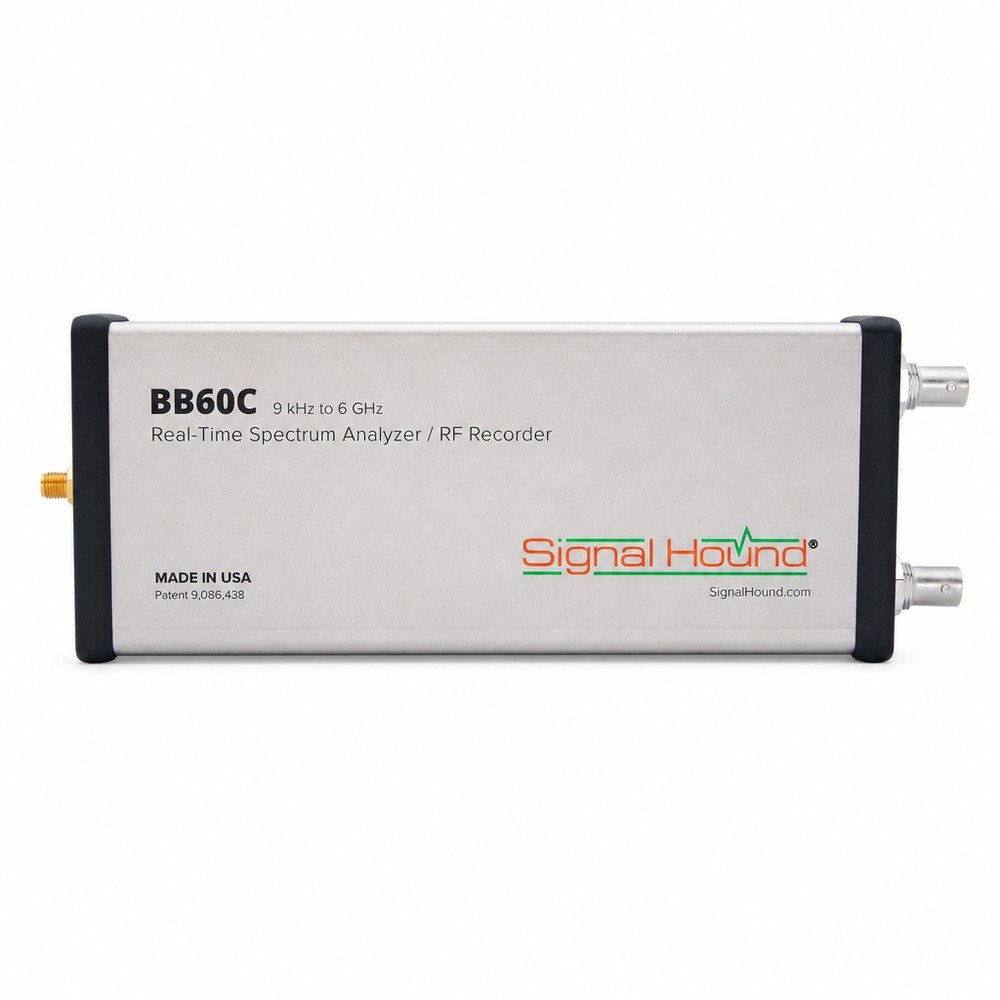
For a crowded band, locate the energy distribution with a wide span first, then narrow the RBW to resolve adjacent signals. The 9 kHz ~ 6.0 GHz range and 24 GHz/s sweep speed allow a full-band pre-scan in one pass, while the 10 Hz ~ 10 MHz RBW range covers both coarse location and fine resolution.
Switch to streaming I/Q when frequency-hopping or transient events must be retained: 27 MHz (calibrated streaming I/Q) sets the gap-free capture width and removes the dwell-time constraint. When a reading approaches the noise floor, record averaging mode, detector type and RBW together — levels measured under different settings are not directly comparable.

Field and station work often requires long unattended recordings. USB 3.0, 6 W, no external PSU enables single-cable deployment, while the down to -158 dBm (10 MHz~6 GHz) DANL and -117 dBc/Hz @1 MHz offset (1 GHz carrier) phase noise define the two limits of weak-signal resolvability.
Phase noise and dynamic range bound close-in observation. -117 dBc/Hz @1 MHz offset (1 GHz carrier) governs whether a weak signal can be resolved next to a strong carrier, while the -158 dBm ~ +10 dBm dynamic range sets the margin for strong and weak signals in one scene; together with RBW they dominate reading uncertainty.
For records, keep frequency range, RBW, detector and averaging mode, and reference level in one log sheet; replay 27 MHz (calibrated streaming I/Q) data with identical settings. USB 3.0, 6 W, no external PSU suits long unattended field work, but antenna feed and supply lines should be routed separately to avoid extra coupling into the front end.
- Specifications: site product master data (model BB60C)
- Method index: ITU-R SM.1753 (spectrum occupancy measurement)