
The distributed test platform entry of 2025-09-12 in this section has been reviewed against the product master data and rewritten as a PCR4200 4-channel configuration record, with timing, link self-check and dynamic-range notes added.

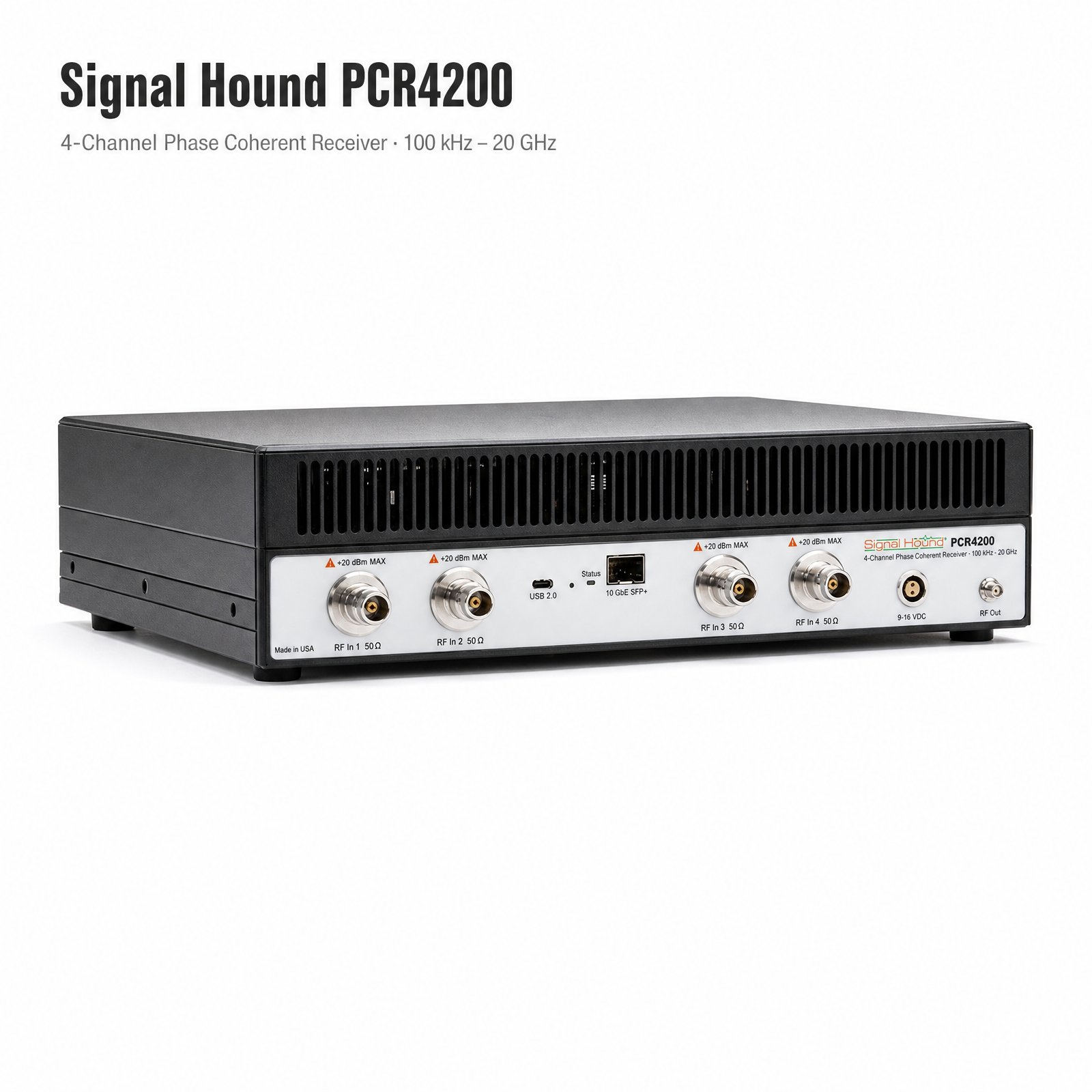
Multi-antenna reception depends on phase consistency. 4 phase-coherent (expandable to 16 channels, up to 4 units cascaded) means all channels share one timing base; cascaded units require a common reference clock and trigger, otherwise inter-channel phase drift directly contaminates subsequent amplitude comparison or direction finding. The 100 kHz ~ 20 GHz range covers the usual monitoring and direction-finding bands.
Size the data link from 40 MHz calibrated I/Q per channel (10GbE SFP+ output): four channels at full load demand adequate switch and storage throughput, with 10GbE SFP+; 9~16 VDC supply. Keep clock lines apart from high-power feed lines. The vector signal generator 30 MHz ~ 20 GHz can inject a known signal for link self-checks of channel amplitude and phase consistency.

Record three limits at acceptance: 110 dB dynamic range sets the margin for strong and weak signals in the same scene, -136 dBc/Hz @10 kHz offset (1 GHz carrier) phase noise sets near-in weak-signal resolution, and up to 160 GHz/s (10 kHz RBW) sweep speed sets the time cost of wide-band surveys. All three come from the product master data.
The timing base is the second prerequisite. When cascaded to 16 channels across up to 4 units, all devices must share a reference clock and trigger distribution; the -136 dBc/Hz @10 kHz offset (1 GHz carrier) phase noise and 110 dB dynamic range set the confidence interval for amplitude-comparison direction finding at the weak-signal end, so record the reference level and inter-channel phase difference at acceptance.
For link self-checks, inject a single tone first and compare amplitude and phase channel by channel, then run a wideband survey at up to 160 GHz/s (10 kHz RBW). Route the 10GbE SFP+; 9~16 VDC data and supply interfaces separately to keep switching noise out of the analog front end. The full specification table below comes from the product master data and can be used directly as an acceptance checklist.
- Specifications: site product master data (model PCR4200)
- Method index: IEEE Std 1588 (precision time synchronisation)