How pre-compliance differs from certification

Certification labs offer traceable measurements, calibrated sites and legally valid reports. Pre-compliance aims for repeatable relative comparison: how many dB did the failing point drop after one shielding change or one new supply filter? The equipment is the same; what differs is calibration grade and the site. What pre-compliance saves is a one-to-two-week turnaround on every iteration.
A practical bill of materials
| Item | Role | Selection notes |
|---|---|---|
| Spectrum analyzer / EMI receiver | Main instrument for radiated and conducted measurements | RBW steps covering 200Hz / 9kHz / 120kHz, with quasi-peak (QP) and average (AV) detectors |
| LISN | Conducted emissions | 50Ω∥50µH impedance network, current rating above the EUT's supply capacity |
| Antenna set | Radiated emissions | Biconical + log-periodic for 30MHz–1GHz, horn above 1GHz |
| Near-field probe set | Board-level troubleshooting | H-field and E-field probes, read directly on the analyzer |
| Test site | Carrier for radiated testing | Semi-anechoic chamber, GTEM cell, or shielded room + near-field sweep |
| Accessories | Protection and calibration | Transient limiter, reference source, low-loss cables, antenna tripod / turntable |
Choosing the analyzer: RBW and detectors decide

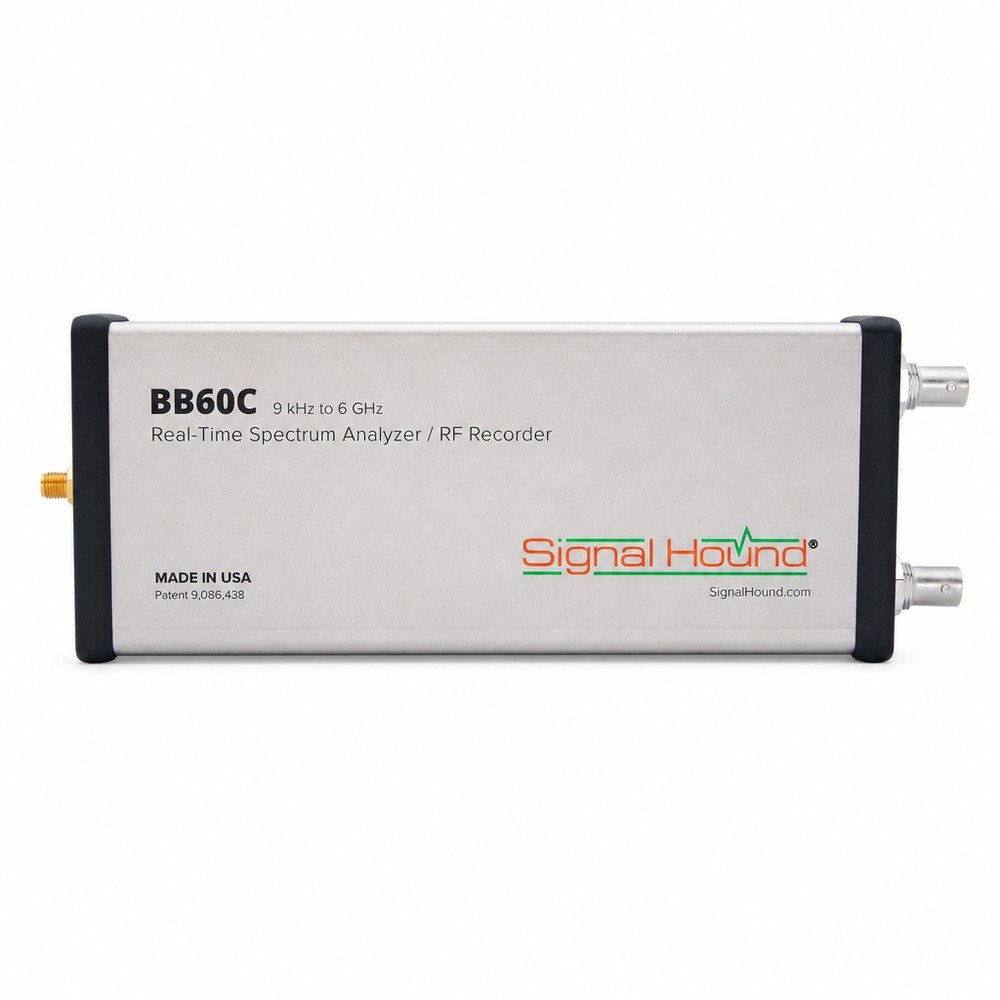
CISPR 16-1-1 fixes the RBW and detectors for compliant measurement: 9kHz RBW for conducted bands (150kHz–30MHz), 120kHz RBW for radiated bands (30MHz–1GHz), reported as quasi-peak and average values. Ordinary spectrum analyzers usually provide peak/average only and lack quasi-peak detection — that is the core difference between a "spectrum analyzer" and an "EMI receiver".
For quick screening, peak detection gives a conservative reading (peak reads above quasi-peak, so nothing fails quietly); upgrade to a QP/AV-capable receiver when you need readings close to certification.
JXBY handheld spectrum analyzers publish a frequency range of 9kHz–20GHz / 26.5GHz, RBW of 1Hz–10MHz and a displayed average noise level of -160dBm — useful as a first-pass tool for field and production checks; for lab-grade pre-compliance, select the main instrument by quasi-peak capability.
The LISN: the gate item for conducted testing
A LISN does two things: it presents a stable impedance to the EUT's supply, and it couples conducted disturbance to the measurement port. Selection comes down to three numbers: impedance network (50Ω∥50µH for consumer; CISPR 25 has a 5µH variant), current rating (above the EUT's maximum current, with margin), and number of lines (single-phase two-line / three-phase four-line).
A transient limiter between the LISN measurement port and the receiver is mandatory — the switch-on transient of an EUT can destroy the receiver front end. It is the classic "cannot-save" expense of a new lab. For the full conducted-emissions setup and layout pitfalls, see the companion article.
Radiated emissions: antennas and the site

The 3-meter method is the usual pre-compliance compromise. A semi-anechoic chamber is closest to certification conditions but costs the most; a GTEM cell is compact and extends to high frequencies, but translating readings to an open-area site needs experience; a shielded room with near-field probes is pure troubleshooting — it gives no limit judgement, but it finds the source before any redesign.
A common budget split: roughly half to instruments, one third to the site, the remainder to accessories and calibration. Money saved on the site is usually eaten by rework.
From pre-compliance to submission: a checklist
- Peak-scan both conducted and radiated bands with comfortable margin (peak is conservative)
- Re-measure failing points with QP and AV detectors to see the real gap to the limit
- Log the three classic fix points: supply filtering, shield bonding, cable routing
- Photograph and archive the fixed setup (EUT placement, cable lengths, grounding) so before/after stays comparable
FAQ
- What is the minimum equipment for EMI pre-compliance?
- A spectrum analyzer or EMI receiver with 9kHz / 120kHz RBW, a LISN matched to the EUT's supply capacity, a transient limiter, and a near-field probe set. For radiated limit judgement you additionally need antennas and a usable site.
- Can an ordinary spectrum analyzer measure EMI?
- Yes, for peak-detector screening — peak reads above quasi-peak so failing points are not missed. Formal pre-compliance readings need quasi-peak and average detectors per CISPR 16-1-1.
- How do I choose the LISN current rating?
- Above the EUT's maximum working current with margin; common steps are 16A / 25A / 63A / 100A. A higher-rated network works fine at light loads, not the other way round.
- What should I buy first on a tight budget?
- Analyzer or receiver → LISN + limiter → near-field probes → antenna set → site upgrade. Get the conducted side working first; troubleshoot radiated issues with near-field probes.
Sources: Spectrum analyzers Handheld spectrum analyzers Shielding effectiveness test Method sections summarize publicly documented CISPR 16 requirements; no non-published parameters are cited.
Pre-sales selection consulting, on-site test planning, operator training and after-sales metrology and calibration services. Phone / WeChat / WhatsApp: +86-15626514602 Email: sales@jxby.tech Service hours 08:00–22:00 (UTC+8).