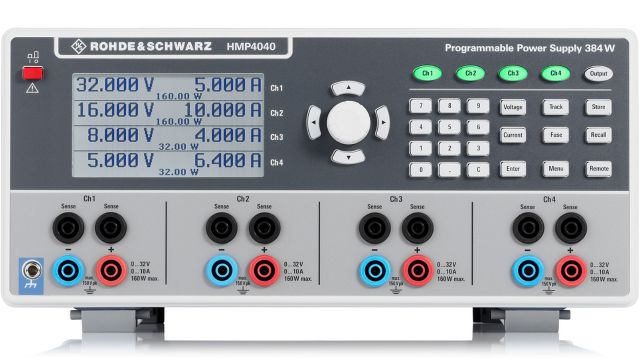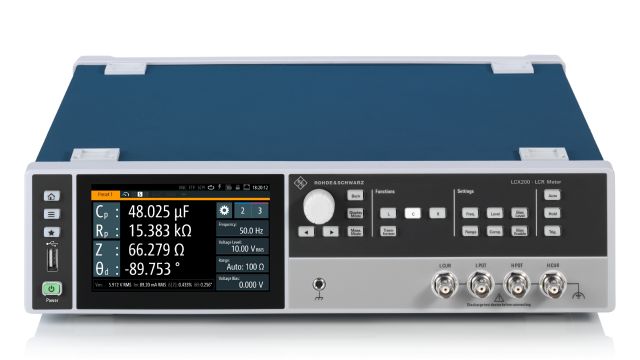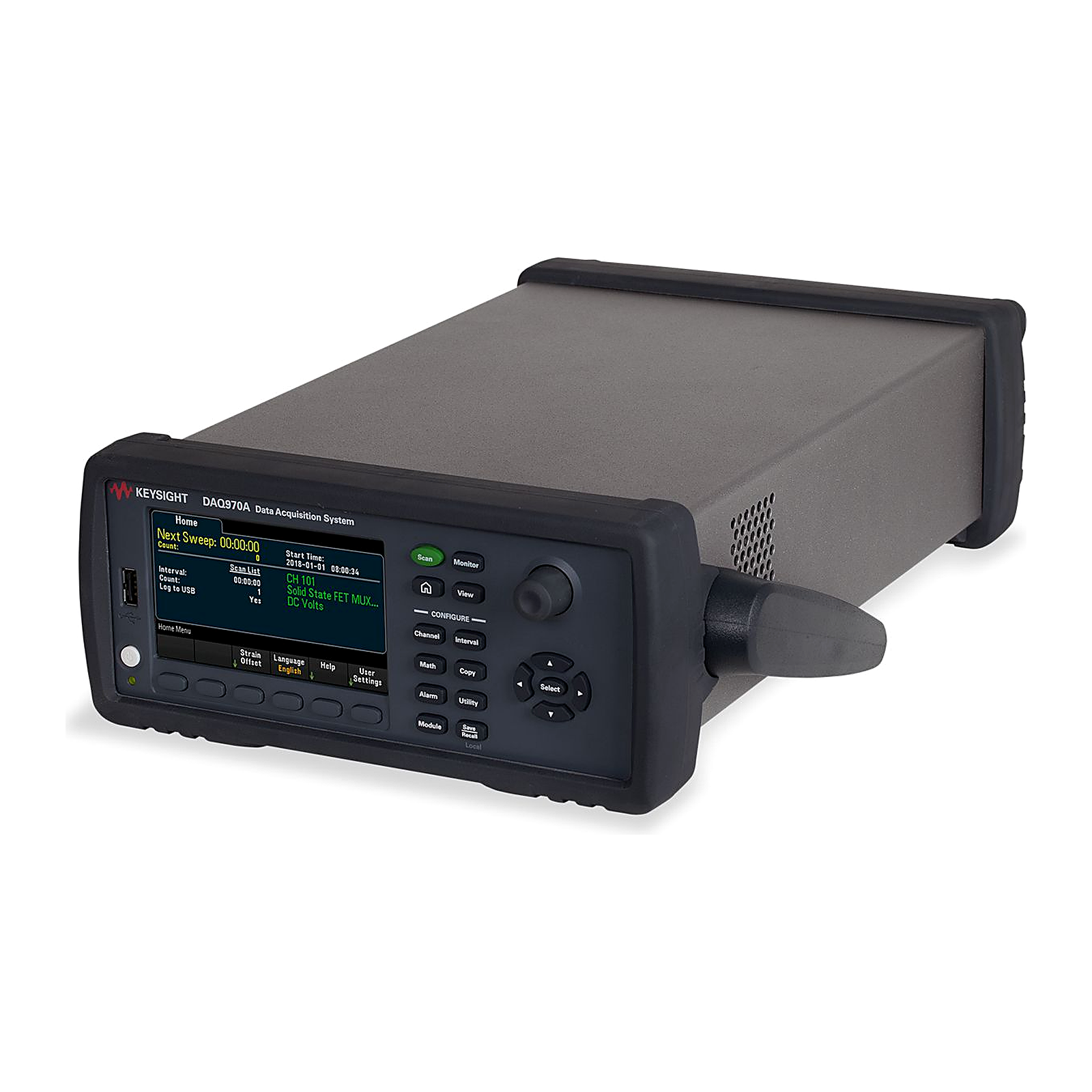
Three series, three different roles

| Series | Positioning | Typical use |
|---|---|---|
| Source measurement unit (SMU) | SMU with integrated sourcing and measurement | Semiconductor characterization, nano-device and material testing |
| Programmable DC power supply | Multi-channel independent outputs | General lab power, production-line testing |
| Wide-range programmable DC switching supply | Wide-range programmable DC switching supply | High-power delivery with voltage/current combinations |
Pick the series first, then the model — once this is fixed, the channel count and accuracy class below start to mean something.
Core specifications of the source meter
Published specifications of the JXBY-7201 series source measurement units:
- Channels: 1 (JXBY-7201) / 2 (JXBY-7202)
- Resolution: 10fA/100nV
- Reading resolution: 6½ digits
- Maximum output: ±210V/3.03A/31.8W
- Pulse capability: ±10.5A
- Sampling rate: 100,000 points/s
The 10fA/100nV resolution is the dividing line between a source meter and an ordinary supply — ordinary supplies only source, and 10fA-level measurement capability is the foundation for semiconductor I-V curves and device characterization.
The 100,000 points/s sampling rate determines whether you can do pulse testing and fast transient observation.
How to decide channels on multi-channel supplies

For the SPD series the key parameters are each channel’s output capability and the channel count. Published examples:
| Model | Max per-channel current | Max per-channel voltage | Max output power | Channels |
|---|---|---|---|---|
| JXBY-7209 | 3.2 A | 32 V | 240 W | 4 |
| JXBY-7212 | 10 A | 15 V | 285 W | 4 |
| JXBY-7210 | 10 A | 12 V | 278 W | 4 |
| JXBY-7207 | 3.2 A | 32 V | 220 W | 3 |
First compute the total power requirement, then check whether the per-channel capability covers the most demanding channel — common practice is to set the current headroom by the highest-load channel rather than configuring every channel to the maximum.
Two ways accuracy is specified
Power-supply accuracy usually comes as two values: setting accuracy and readback accuracy.
Published values for the JXBY-7209 series:
- Resolution: 1 mV/1 mA
- Setting accuracy: voltage ±(0.03% of reading+10)mV; current ±(0.3% of reading+10)mA
- Readback accuracy: voltage ±(0.03% of reading+10)mV; current ±(0.3% of reading+10)mA
“of reading” means a percentage of the reading — a point often misread. For example, at a 10V setpoint, the voltage setting error = 10V × 0.03% + 10mV = 3mV + 10mV = 13mV. The larger the range, the smaller the percentage term’s share and the more the fixed term dominates.
How high-power models differ

The same series also has high-power tiers: the JXBY-7230 series delivers 1500W, uses a 3.12-inch OLED display, and supports independent, series and parallel output modes.
One published model: max per-channel current 120A, max per-channel voltage 40V, max output power 1500W, 1 channel, resolution 10 mV/10 mA, setting accuracy 0.2%±30mA (current) / 0.1%±10mV (voltage), readback accuracy 0.2%±40mA (current) / 0.1%±20mV (voltage).
Note that high-power tiers trade off resolution (10 mV/10 mA vs 1 mV/1 mA): resolution and power cannot both be maximized — an inherent trade-off in power supplies.
FAQ
- What is the core difference between an SMU and an ordinary DC supply?
- An ordinary DC supply only sources voltage and current — measurement needs an external multimeter; an SMU sources and measures simultaneously, integrating a current source, voltage source, voltmeter and ammeter with four-quadrant operation. Take the JXBY-7201: 10fA/100nV resolution, 6½-digit reading resolution, 100,000 points/s sampling rate.
- How do I decide the channel count of a multi-channel supply?
- Compute the total power requirement first, then check whether per-channel capability covers the most demanding channel. In the programmable DC supply range, the SPD4000X is 3.2A/32V/240W with 4 channels, the SPD4323X is 10A/15V/285W with 4 channels, and the SPD3303C is 3.2A/32V/220W with 3 channels.
- How should I read a power supply’s accuracy figures?
- Look at two values: setting accuracy and readback accuracy, published as “±(percentage of reading + fixed value)”. For the JXBY-7209, voltage setting accuracy is ±(0.03% of reading+10)mV and current ±(0.3% of reading+10)mA. The percentage scales with the reading; on larger ranges the fixed term dominates.
- Does resolution drop on high-power supplies?
- Yes — an inherent trade-off. High-power tiers like the JXBY-7230 series (1500W, max per-channel 120A/40V) offer 10 mV/10 mA resolution, while mid-power SPD4000X-series units offer 1 mV/1 mA. Resolution and output power must be balanced against actual needs.
This guide is based on the official product pages and solution descriptions /products/dc-power-supply-and-smu/. Parameters are quoted verbatim, without secondary processing.
We provide pre-sales selection consulting, on-site solution planning, technical support, operator training and after-sales calibration services. Phone / WeChat / WhatsApp: +86-15626514602 Email: sales@jxby.tech Service hours 08:00–22:00.
Address: Room 412, Building 1, Phase 1, Dongjiu Innovation Technology Park, No. 76 Bulan Road, Xialilang Community, Nanwan Street, Longgang District, Shenzhen, Guangdong, China